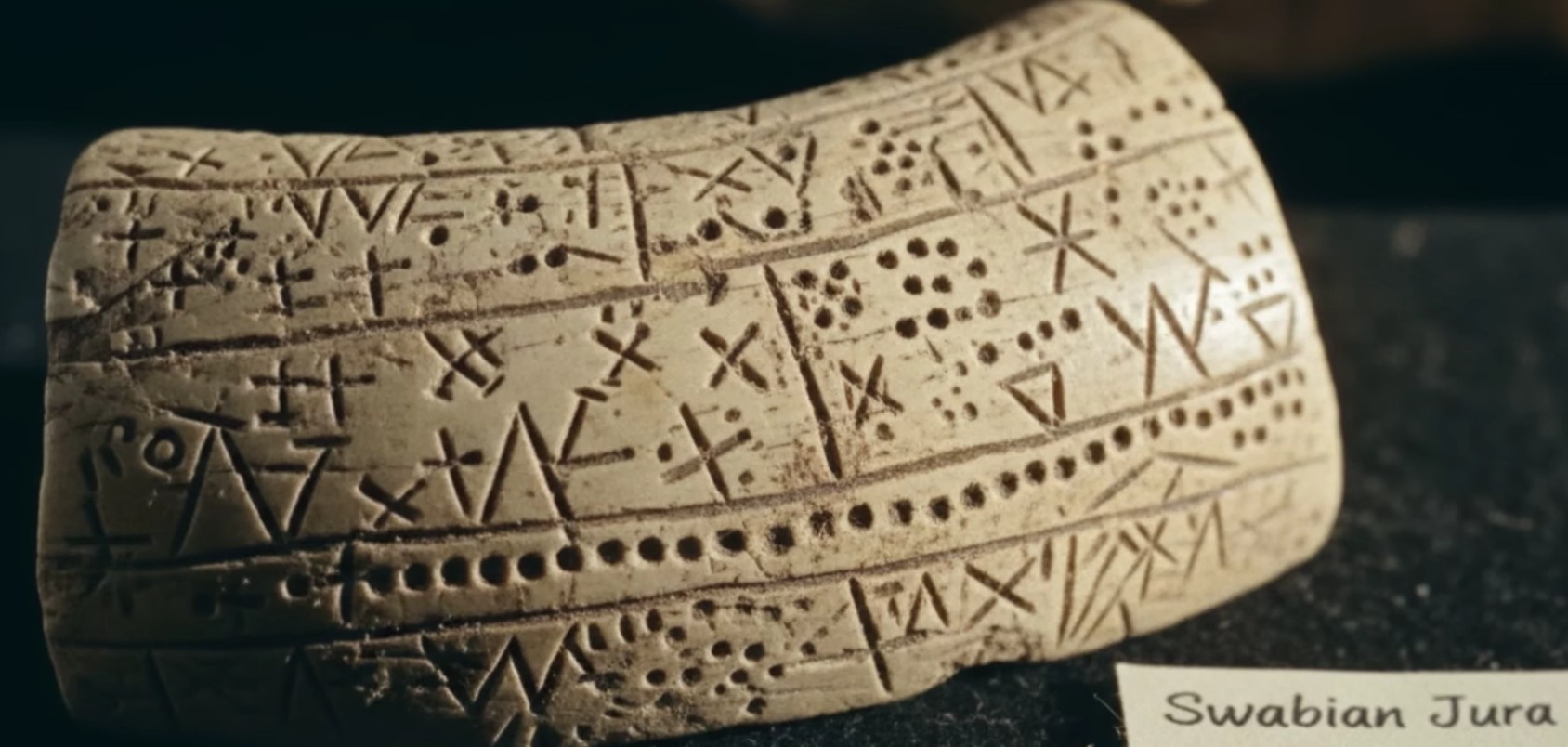
Aurignacian marks dated between 43,000-34,000 years ago
Image Source: New Discovery of World's Oldest Writing Rewrites Human History, at 1:30
Introducing IdeaFarm (tm) Knowledge Trees, and IdeaNet (tm) Books by IdeaFarm (tm)
IDEAFARM.COM will address literacy by introducing a fundamentally new form of writing, the "knowledge tree", that makes both writing and reading much easier and much more effective. Humans have been using sequences of symbols to represent information for 40,000 years, and to represent speech for 5,000 years. Although the variety of applications of this technique has exploded, the technique itself, stringing symbols together in a line, has not changed in 40,000 years. Until now. In a knowledge tree, each idea is expressed in the conventional way, as a linear sequence of symbols (a sentence). But rather than presenting those sentences in a linear sequence, a knowledge tree arranges them in a tree structure.
Reading a knowledge tree is like climbing a tree. With conventional linear writing, the reader encounters each idea (sentence) sequentially, from beginning to end. With a knowledge tree, the reader encounters the single "root" idea (sentence, now called a "branch") that summarizes the entire writing. He or she then "climbs up" a level and encounters a (linear) sequence of about eight ideas (branches) that, together, explain the meaning of the root idea. Each of those approximately eight ideas (branches) can have about eight branches growing upward. There is no limit to the number of levels of detail, and branches can have a varying number of levels of detail. Rather than reading the entire tree, the reader actively decides how far up to explore each idea (branch).
Visually, each browser page presents three levels of the knowledge tree as a sequence of paragraphs. The lowest level displayed on the page is a single branch (sentence), which appears as the page title. The first sentence of each paragraph is a branch at the next level of detail; those branches comprise the entire explanation of the title branch. The other sentences of each paragraph are branches at the highest level of detail. For each paragraph, the other sentences explain the first sentence. Clicking the first sentence of a paragraph thus climbs up one level to display the page for that paragraph. Clicking any other sentence thus climbs up two levels to display the page for that sentence.
The key benefit for the reader of presenting ideas in this way is that complexity is broken down into simple, digestible, small pieces. As the reader explores any branch in the tree, he or she is only digesting a single idea by reading a single sequence of about eight explanatory ideas.
The key benefit for the writer is that he or she can simultaneously write for multiple audiences with varying interests and reading skills. With conventional writing, the author must select a target audience and then let that choice guide the level of detail and vocabulary with which to explain each idea. But when writing a knowledge tree, all detail is provided, and each reader chooses how far to climb up into the tree to explore each idea. To maximize accessibility, the author can express each idea in the lower levels of the tree using simple, common words, while exploiting the full power and vocabulary of the English language, including specialized technical jargon, in the higher levels. In this way, the writing is accessible to persons with limited vocabulary and reading skill, while also satisfying the more demanding requirements of other audiences.
Knowledge tree writing imposes structure, which both empowers and restricts the writer. Conventional writing is "free form" in that any sentence in a paragraph can be the topic sentence, paragraphs can be presented in any order, and the topic of each paragraph is unconstrained by the topics of the other paragraphs nearby. In a knowledge tree, each paragraph always begins with its topic sentence, and that topic sentence (branch) must directly explain the branch "below" from which it grows. Conventional writing can ramble and meander or even be insanely incoherent in the sequence of ideas presented. With a knowledge tree, the writer begins with an arbitrary "root" idea, but all of the other ideas in the writing must be arranged in small sequences that explain some other idea in the tree.
Finally, knowledge tree writing can be either "pure" or "hybrid". A pure knowledge tree conforms to the imposed structure throughout. But nothing prevents the author from explaining a particular branch with a linear sequence of free form ideas (conventional writing). For example, a single knowledge tree can include multiple conventional essays within a structure that thus partially, but not completely, conforms to the structure of a pure knowledge tree.
IdeaNet (tm) Books by IdeaFarm (tm) is the "subscribers only" part of IDEAFARM.COM. Each IdeaNet (tm) Book is a knowledge tree, either pure or hybrid, that a "key program" displays using your default browser. The system is designed to allow access only by paid human subscribers, to prevent AI scraping, and to prevent DDOS attacks intended to silence the authors.
The 87% of young people who are functionally illiterate, who do not have the "foundational capacity" to read and comprehend this presentation, can do so by helping each other. If you are struggling to read this introduction, take your time, stick with it, and help each other in group study. Study together to master each paragraph before continuing to the next. Don't be competitive; approach intellectual conversation as a banquet, not as a race. People will "catch on" with differing amounts of effort for a variety of reasons, so don't be bothered if someone else catches on faster than you do. As the Desiderata says so beautifully, "Do not compare yourself with others, lest you become vain and bitter, for there will always be persons greater than and less than yourself". To continue, click [#8] the word "leisurely" after the colon: Give yourself time for thoughtful reading at a leisurely pace.